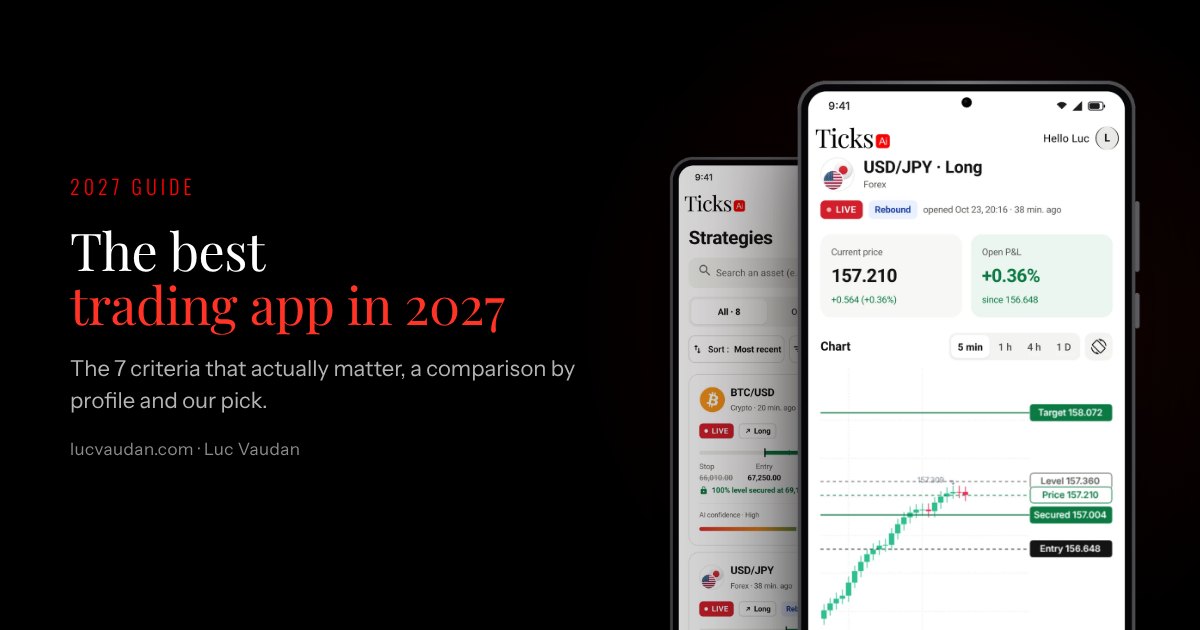
In short: in 2027, almost every trading app can place an order quickly and cheaply. What makes the difference is no longer execution, it's the quality of your decisions: which trade to take, at what price to enter and, above all, when to exit. For execution, a regulated broker is enough. For better decisions, our pick is Ticks AI 2.0, available from 5 November 2026: it spots the strategies its algorithm rates highest across five markets, walks you from entry to exit and protects your gains level by level.
Disclosure: Ticks is published by Genius AI Pte. Ltd. (Singapore), the company founded by Luc Vaudan, who runs this site. We obviously have an interest in recommending it. That's why this article spells out our criteria, presents the alternatives and lists its sources, so you can judge for yourself.
Aussi disponible en français : Meilleure application de trading en 2027.
App rankings mostly compare fees, ease of use and the number of markets. Those are good criteria, but they miss the point: the vast majority of retail traders lose money, whatever the app.
If the vast majority of retail traders lose while platforms are fast and cheap, the problem isn't the execution tool. The problem is decisions: taking the wrong trade, entering at the wrong price and, above all, mishandling the exit, by cutting a winner too early or letting a loser run.
Three trends are reshaping trading apps.
Payment for order flow, which let some apps advertise zero commission while being paid by execution venues, is banned in the European Union under MiFIR. Germany, which had a transition period, has applied the ban in full since 1 July 2026. Business models are becoming clearer, and the question becomes: what does the app actually give you beyond market access?
ESMA has stated that nudges leading to compulsive trading are never in the investor's interest, and has raised concerns about the "gamification" of apps, confetti included. In the UK, in a CFD warning published in late 2025, the FCA also cautioned against "finfluencers" promoting unregulated firms. The best app in 2027 is therefore the one that makes you trade better, not more.
Apps that put "AI" on their homepage are multiplying. The right question isn't "is there AI?", but: are the strategies explained, their risks quantified and their full track record visible, losses included?
There's no single ideal app for everyone. Here are the market's references depending on what you need. These descriptions are general: always check the terms and fees that apply in your country.
In practice, the most useful setup for 2027 is often twofold: a regulated broker to execute, and a tool that helps you make better decisions.
Ticks continuously scans hundreds of instruments across five markets (Forex, indices, commodities, crypto and stocks) and keeps only a handful of strategies. You no longer spend your days hunting for a trade: qualified strategies come to you, already ranked.
No bare "buy". Each strategy comes with its entry, target, protection and a suggested position size, plus its score and track record. Reading them, you learn what separates a solid strategy from a gamble.
This is what almost every app leaves out. Ticks notifies you when a strategy is found, when the entry price is reached and when it's time to exit. You don't have to stay glued to the screen.
The exit isn't a fixed target: a ratchet raises the protection as the position moves in your favour. It can lock in a gain before the target if momentum fades, or let it run beyond if the move continues. The protection moves up level by level, without guaranteeing the gain: a price gap or slippage can still give part of it back.
The history of closed strategies is complete: wins and losses, with win rate and risk/reward. That's honest, and it's educational: you learn that losses are part of the game and that management matters more than luck.
You decide whether to follow each strategy. And if your broker offers an autotrading service, Ticks can connect to it to execute automatically, from entry to exit. It's an option, not an obligation.
Ticks is built around the Genius AI algorithm, designed by a team of traders, quants and developers led by Luc Vaudan, a trader for more than thirty years and founder of France's first accredited trading school.
To go further, read The Price Excess Strategy and our introduction to Ticks AI. Want to know where you're losing money? See why an audit of your trades is the most useful service in 2027, or request a free mini-audit of your last 20 trades.
It depends on your goal. For long-term investing, a simple regulated broker such as Trade Republic works well. For active trading across many markets, Interactive Brokers is a reference. To decide better which trades to take and when to exit, our pick is Ticks AI 2.0, used alongside the broker of your choice.
No. Ticks is a decision-support app: it selects and explains strategies, then walks you from entry to exit. Your orders are placed with your broker.
Crypto strategies are free, with no trial and no end date. The other markets (Forex, indices, commodities, stocks, ETFs) unlock with the Ticks — All Markets subscription, taken in the app through the App Store or Google Play: €99.99 a month or €899.99 a year in the eurozone ($89.99 or $799.99 in the US). The price shown in your store applies.
No. No app can guarantee profits. Trading involves a risk of capital loss, and a serious app says so clearly and shows its losses.
Start with a regulated broker, small amounts and a tool that explains why a trade is taken. Avoid apps that push you to trade often with rewards or leaderboards.
Be wary. European and UK regulators regularly warn about "finfluencers" who steer people towards risky products or unauthorised firms. Always demand a method, risk management and a complete track record.
Look it up in your regulator's register: the FCA Financial Services Register in the UK, your national authority in the EU (in France, the REGAFI register and the AMF blacklists).
From 5 November 2026, on the App Store and Google Play.
Trading involves a risk of capital loss. This article is general information and not investment advice. Past performance does not predict future results.