In trading, at the very beginning, there are no company balance sheets, no financial ratios, no sophisticated indicators. There are just charts — simple curves that rise, fall, accelerate, and slow down. And until you see what drives them, trading remains a string of abstract symbols on a screen. The first idea behind this method, born from more than thirty years of practice, fits in a single sentence: your chart is alive.
Behind every contour on a chart, there is a force that created it. The engine of that force is a permanent struggle between two camps: buyers, who want prices to rise, and sellers, who want them to fall. These two camps never negotiate — they clash through price alone. Every move you see on screen is therefore not the result of economic rationality, but of a balance of forces. The whole craft consists of identifying who is strongest at the present moment, so you can position yourself in their wake — like the lead carriage hooked directly to the locomotive.
No force lasts forever. Buyers run out of breath, sellers regain control, and vice versa. When a move goes too far, too fast, it creates an excess — and markets share one universal, inescapable tendency: they return toward equilibrium after any excessive move. The price excess strategy is precisely about identifying, measuring, and exploiting these imbalances, whether they arise naturally or are created artificially.
This approach makes no promise of earning thousands a month working an hour a day — those promises are scams. Nor does it predict anything: it won't tell you where the S&P 500 will be in six months. The excess method doesn't predict — it reacts intelligently to market moves. It's a practitioner's approach, for practitioners: clear, structured, applicable, and rooted in the physical reality of markets. Many intermediate traders end up abandoning their indicators once they understand it — not because they were told to, but because they realize those indicators were hiding what mattered most.
The trading world has changed profoundly. Artificial intelligence has entered the trading floor, high-frequency algorithms now drive the majority of volume, flash crashes are increasingly common, crypto markets have created new kinds of excess, and institutional manipulation has grown more subtle. The 2026 edition covers all of this — fine candle reading, algorithmic excesses, AI applied to trading, and real case studies (CHF 2015, crypto flash crashes, Hormuz 2024–2025) — with the legitimacy of someone who built an institutional AI trading platform, Genius AI.
The motivated beginner looking for a solid foundation rather than a miracle system. The intermediate trader whose equity curve hovers around zero and who finally wants a rigorous approach. And the professional seeking an additional perspective and a systematic way to analyze excesses. The only condition: a willingness to invest the time it takes.
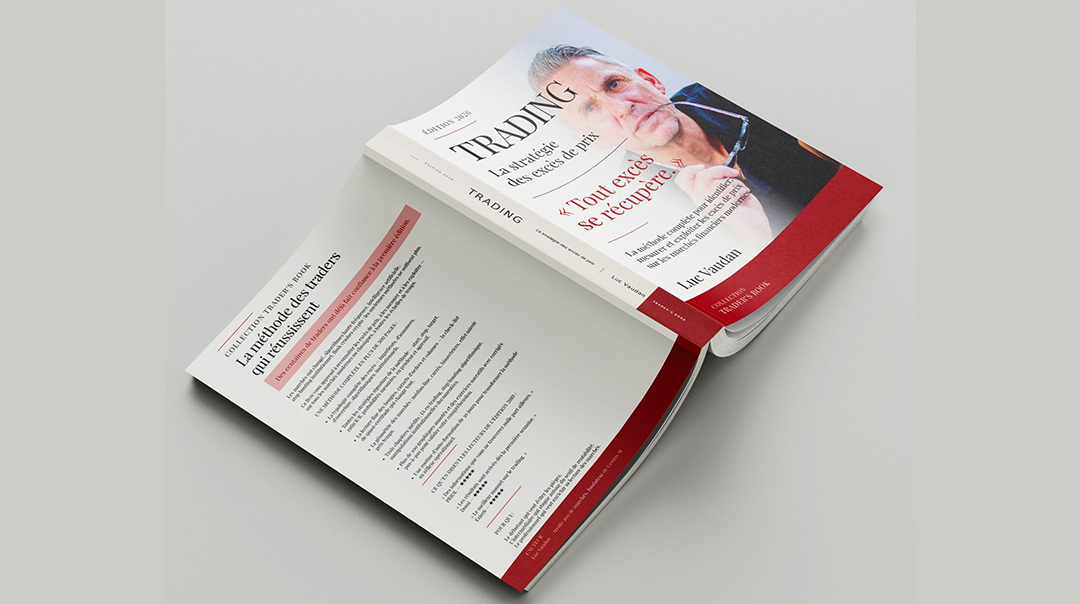
TRADING — The Price Excess Strategy (2026 edition, fully rewritten and expanded, Trader's Book Collection) brings together the complete method, its signature strategies, and its case studies. A practice companion you annotate, reread, and consult daily — not a book you shelve after one read.
Does the price excess strategy work on all markets?
Yes. It's a cross-market approach — stocks, indices, currencies, commodities, futures, and crypto — because it relies on what's universal to every market: order flow, volume, and the tendency to revert to equilibrium after any excessive move.
Do I need to know technical indicators to apply it?
No. The method starts from the chart itself — the candle, the order book, volume, and the geometry of price — rather than from layered indicators. Many traders actually set their indicators aside once they learn to read excesses directly.
Is this for short-term trading or long-term investing?
It's a short- to medium-term approach. The strategy reacts to excessive moves and their return to balance, so it suits active traders rather than buy-and-hold investors building a 20-year portfolio.
Luc Vaudan, TRADING — The Price Excess Strategy, Trader's Book Collection (2026 edition, fully rewritten from the 2019 original).
Steve Nison, Japanese Candlestick Charting Techniques — the reference work that popularized candle reading (body, wicks, shadows) in the West.
Swiss National Bank, press release of 15 January 2015 on abandoning the 1.20 CHF/EUR floor — a textbook case of a sudden institutional shock and the market's violent return to equilibrium.
#trading #priceaction #investing #AI #marketstructure